
Md. Joynal Abdin
Business Consultant | Entrepreneur | International Trade Specialist
Founder & Chief Executive Officer, Trade & Investment Bangladesh (T&IB)
Secretary General, Brazil Bangladesh Chamber of Commerce & Industry (BBCCI)
Exporting is one of the most effective ways to grow a business beyond the limitations of the domestic market. While Bangladesh has earned global recognition as one of the world’s leading exporters of ready-made garments, the country’s export potential extends far beyond apparel. Bangladeshi entrepreneurs are increasingly finding opportunities to export leather goods, footwear, pharmaceuticals, jute and jute products, frozen foods, ceramics, plastics, light engineering products, agricultural products, software, information technology services, home textiles, handicrafts, bicycles, processed foods, and many other value-added products.
Today, buyers from Europe, North America, the Middle East, Asia, Africa, Latin America, and Oceania are actively searching for reliable suppliers capable of delivering quality products at competitive prices. Digital technology, international trade platforms, and improved logistics have made global markets more accessible than ever before. Even a small or medium-sized enterprise (SME) in Bangladesh can now reach international buyers without establishing overseas offices.
Despite these opportunities, many entrepreneurs hesitate to enter export markets because they believe exporting is complicated, expensive, or reserved only for large corporations. In reality, successful exporting is primarily about proper planning, regulatory compliance, market research, product quality, and building long-term relationships with international buyers.
This comprehensive guide explains how to start exporting from Bangladesh step by step, enabling entrepreneurs to confidently develop an export business and compete successfully in international markets.
Why Should Bangladeshi Businesses Export?
Exporting offers numerous strategic advantages beyond increasing sales. Businesses that export can:
- Access significantly larger international markets.
- Reduce dependence on the domestic economy.
- Earn valuable foreign currency.
- Improve production efficiency through larger order volumes.
- Build internationally recognized brands.
- Increase profitability through diversified markets.
- Enhance product quality by meeting global standards.
- Reduce business risks by serving multiple countries.
For Bangladesh, expanding exports is also essential for employment generation, industrial development, technology transfer, and sustainable economic growth.
Bangladesh’s Export Potential
Bangladesh has evolved into one of Asia’s fastest-growing export economies. While ready-made garments remain the dominant export sector, global demand is increasing for many other Bangladeshi products.
Promising export sectors include:
- Ready-made garments
- Knitwear
- Home textiles
- Leather products
- Footwear
- Jute and jute goods
- Pharmaceuticals
- Frozen fish and seafood
- Agro-processed foods
- Tea
- Ceramic products
- Plastic products
- Bicycle manufacturing
- Light engineering products
- Information technology services
- Software development
- Furniture
- Handicrafts
- Herbal products
Entrepreneurs should identify products where Bangladesh has comparative advantages regarding cost, quality, raw materials, or skilled labor.
Step 1: Evaluate Your Product for Export Readiness
Not every product is immediately suitable for export. Before approaching foreign buyers, evaluate whether your product meets international expectations regarding:
- Product quality
- Consistency
- Production capacity
- Packaging
- Durability
- Shelf life
- Safety
- Environmental compliance
- International certifications
Ask yourself:
- Can I supply large orders consistently?
- Can I maintain identical quality?
- Can my production increase if demand rises?
- Does my product comply with importing country’s regulations?
Export begins with product readiness—not buyer readiness.
Step 2: Conduct International Market Research
Never export simply because someone suggests a country. Successful exporters conduct detailed market research before selecting export destinations.
Research should include:
- Market demand
- Consumer preferences
- Import trends
- Competitor analysis
- Average selling prices
- Import duties
- Local regulations
- Distribution channels
- Seasonal demand
- Cultural preferences
Reliable market research minimizes risks and improves business decisions.
Step 3: Select the Right Export Market
Instead of targeting the entire world, focus on one or two promising markets initially. Selection criteria include:
- Product demand
- Market size
- Ease of market entry
- Shipping costs
- Trade agreements
- Language barriers
- Political stability
- Currency risks
- Competition
- Payment security
Starting with carefully selected markets allows businesses to build experience before expanding internationally.
Step 4: Understand Product Standards and Certifications
Different countries have different import requirements. Depending on your product, buyers may require certifications such as:
- ISO
- HACCP
- GMP
- Organic certification
- Halal certification
- CE marking
- FSC certification
- REACH compliance
Failure to comply may result in shipment rejection. Understanding regulatory requirements before production saves both time and money.
Step 5: Register Your Business Properly
A legally registered business enhances credibility with international buyers. Ensure your business possesses:
- Valid Trade License
- Tax Identification Number (TIN)
- VAT Registration (where applicable)
- Bank Account
- Company Registration (if incorporated)
Professional documentation builds buyer confidence.
Step 6: Obtain an Export Registration Certificate (ERC)
No business can legally export commercial products from Bangladesh without obtaining an Export Registration Certificate (ERC).
The ERC is issued through the appropriate government authority and is essential for customs clearance and export documentation.
Entrepreneurs should understand:
- Eligibility requirements
- Required documents
- Application procedures
- Renewal requirements
Obtaining the ERC should be completed before negotiating export orders.
Step 7: Open an Export-Friendly Bank Account
International trade depends heavily on banking services. Select a commercial bank experienced in international trade.
Discuss:
- Letter of Credit (L/C)
- Foreign currency accounts
- Export finance
- Export incentives
- Documentary collections
- Telegraphic Transfer (TT)
- Bank guarantees
Your bank becomes a strategic partner in international business.
Step 8: Develop an Export Marketing Strategy
International buyers rarely discover exporters by chance. Successful exporters implement structured marketing strategies including:
- Professional branding
- Company profile
- Product catalogue
- Export brochure
- Product photography
- Corporate videos
- Website
- Digital marketing
Export marketing focuses on building credibility rather than immediate sales.
Step 9: Build a Professional Website
A professional website serves as your global showroom. Your export website should include:
- Company profile
- Product catalogue
- Manufacturing capabilities
- Certifications
- Factory photographs
- Quality assurance
- Export markets served
- Contact information
- Inquiry forms
International buyers almost always verify suppliers online before initiating business.
Step 10: Find International Buyers
Finding qualified buyers is often the greatest challenge for new exporters. Effective methods include:
- International trade fairs
- Trade missions
- B2B marketplaces
- Chamber of Commerce networks
- Trade associations
- Commercial counselors
- LinkedIn networking
- Google Search
- Overseas distributors
- Buyer–Seller Matchmaking programs
Building long-term buyer relationships requires patience, professionalism, and consistency.
Step 11: Communicate Professionally with International Buyers
Finding a buyer is only the beginning. Converting an inquiry into a confirmed export order depends largely on professional communication. International buyers expect prompt, accurate, and courteous responses.
When communicating with buyers:
- Reply to emails within 24 hours.
- Answer every question clearly and accurately.
- Provide a professional company profile.
- Share product catalogues and technical specifications.
- Send high-quality product photographs and videos.
- Clearly state your production capacity.
- Mention your certifications and quality control systems.
- Maintain professional business etiquette at all times.
Remember that international buyers evaluate not only your products but also your professionalism, responsiveness, and reliability.
Step 12: Prepare Competitive Export Pricing
One of the biggest mistakes new exporters make is offering prices without understanding export costing.
Your export price should include:
- Raw material costs
- Labour costs
- Factory overheads
- Packaging expenses
- Inland transportation
- Customs documentation
- Freight charges
- Insurance
- Banking charges
- Commission (if applicable)
- Profit margin
You should also understand internationally accepted trade terms (Incoterms), such as:
- EXW (Ex Works)
- FOB (Free on Board)
- CFR (Cost and Freight)
- CIF (Cost, Insurance and Freight)
- DAP (Delivered at Place)
Selecting the appropriate pricing method prevents misunderstandings and protects your profitability.
Step 13: Negotiate Export Contracts Carefully
An export contract protects both the exporter and the buyer. Every export agreement should clearly specify:
- Product description
- Quantity
- Unit price
- Total contract value
- Product specifications
- Packaging requirements
- Delivery schedule
- Payment terms
- Inspection requirements
- Shipping terms
- Insurance responsibilities
- Dispute resolution mechanism
Never rely solely on verbal agreements. Well-drafted contracts reduce commercial risks and strengthen long-term business relationships.
Step 14: Maintain Consistent Product Quality
Quality determines whether buyers place repeat orders. International buyers expect:
- Consistent specifications
- Uniform product quality
- Proper packaging
- Timely delivery
- Compliance with agreed standards
Businesses should establish strong quality control systems throughout production. Regular inspections before shipment significantly reduce rejection risks. Remember, one poor shipment can permanently damage your international reputation.
Step 15: Prepare Export Documentation
Export documentation is one of the most critical aspects of international trade. Common export documents include:
- Commercial Invoice
- Packing List
- Bill of Lading or Air Waybill
- Certificate of Origin
- Export Registration Certificate (ERC)
- Letter of Credit (if applicable)
- Insurance Certificate
- Inspection Certificate
- Phytosanitary Certificate (where required)
- Health Certificate (for food products)
- Fumigation Certificate (when applicable)
- Export Declaration
- Shipping Instructions
Incomplete or inaccurate documentation can delay customs clearance and increase costs.
Professional exporters maintain organized documentation systems for every shipment.
Step 16: Packaging and Labelling for International Markets
Export packaging is very different from domestic packaging. Good export packaging should:
- Protect products during long-distance transportation.
- Comply with importing country regulations.
- Display required product information.
- Minimize damage during handling.
- Reduce shipping costs.
- Enhance product presentation.
Labels may need to include:
- Product name
- Country of origin
- Manufacturer information
- Batch number
- Production date
- Expiry date
- Storage instructions
- Safety warnings
- Barcode
Proper packaging reflects professionalism and strengthens buyer confidence.
Step 17: Arrange International Logistics
Selecting the right logistics partner is essential for successful exporting. Businesses should work with experienced:
- Freight forwarders
- Shipping lines
- Airlines
- Customs brokers
- Logistics providers
Factors to consider include:
- Shipping cost
- Transit time
- Cargo safety
- Route reliability
- Insurance coverage
- Tracking facilities
Efficient logistics reduce delivery delays and improve customer satisfaction.
Step 18: Complete Customs Clearance
Before goods leave Bangladesh, they must pass through customs procedures. Exporters should ensure:
- Correct HS Codes
- Accurate declarations
- Complete documentation
- Compliance with customs regulations
- Proper valuation
- Timely submission of documents
Working with experienced Customs Clearing and Forwarding (C&F) agents can simplify the customs process and reduce delays.
Step 19: Understand International Payment Methods
Payment security is one of the most important considerations in exporting. Common payment methods include:
Letter of Credit (L/C): The most secure payment method for many exporters, especially when dealing with new buyers.
Telegraphic Transfer (TT): Funds are transferred electronically between banks. Many exporters request advance payments or partial advance payments.
Documents Against Payment (D/P): The buyer receives shipping documents only after making payment.
Documents Against Acceptance (D/A): The buyer accepts a time draft and pays at a future agreed date.
Open Account: The exporter ships goods before receiving payment. This method should generally be used only with long-term, highly trusted buyers.
Before accepting any payment method, exporters should assess the buyer’s financial strength, payment history, and country risk.
Step 20: Provide Excellent After-Sales Service
Exporting does not end when the shipment reaches the buyer. Successful exporters continue to build relationships by:
- Confirming receipt of the shipment.
- Seeking customer feedback.
- Resolving complaints promptly.
- Providing technical assistance when required.
- Informing buyers about new products.
- Maintaining regular communication.
Long-term buyers are significantly more valuable than one-time customers. Strong after-sales service encourages repeat orders and referrals.
Common Export Mistakes to Avoid
Many first-time exporters make avoidable mistakes that can lead to financial losses or damaged business relationships. Some of the most common mistakes include:
- Entering export markets without proper research.
- Accepting orders beyond production capacity.
- Ignoring international quality standards.
- Underpricing products.
- Weak documentation practices.
- Poor communication with buyers.
- Shipping products without adequate quality inspection.
- Depending on a single buyer or a single market.
- Neglecting digital marketing and branding.
- Failing to understand payment risks.
Avoiding these mistakes significantly improves the likelihood of export success.
Government Support Available for Exporters
Bangladesh offers a range of institutional support services to encourage export development. Entrepreneurs should actively engage with organizations such as:
- Export Promotion Bureau (EPB)
- Ministry of Commerce
- Bangladesh Investment Development Authority (BIDA)
- Bangladesh Bank
- National Board of Revenue (NBR)
- Bangladesh Small and Cottage Industries Corporation (BSCIC)
- Bangladesh Foreign Trade Institute (BFTI)
- Bangladesh Standards and Testing Institution (BSTI)
- Federation of Bangladesh Chambers of Commerce and Industry (FBCCI)
- Sector-specific trade associations and chambers of commerce
These institutions provide policy support, export information, training, market intelligence, trade fair participation, and export promotion services.

How Trade & Investment Bangladesh (T&IB) Can Help You Become an Exporter
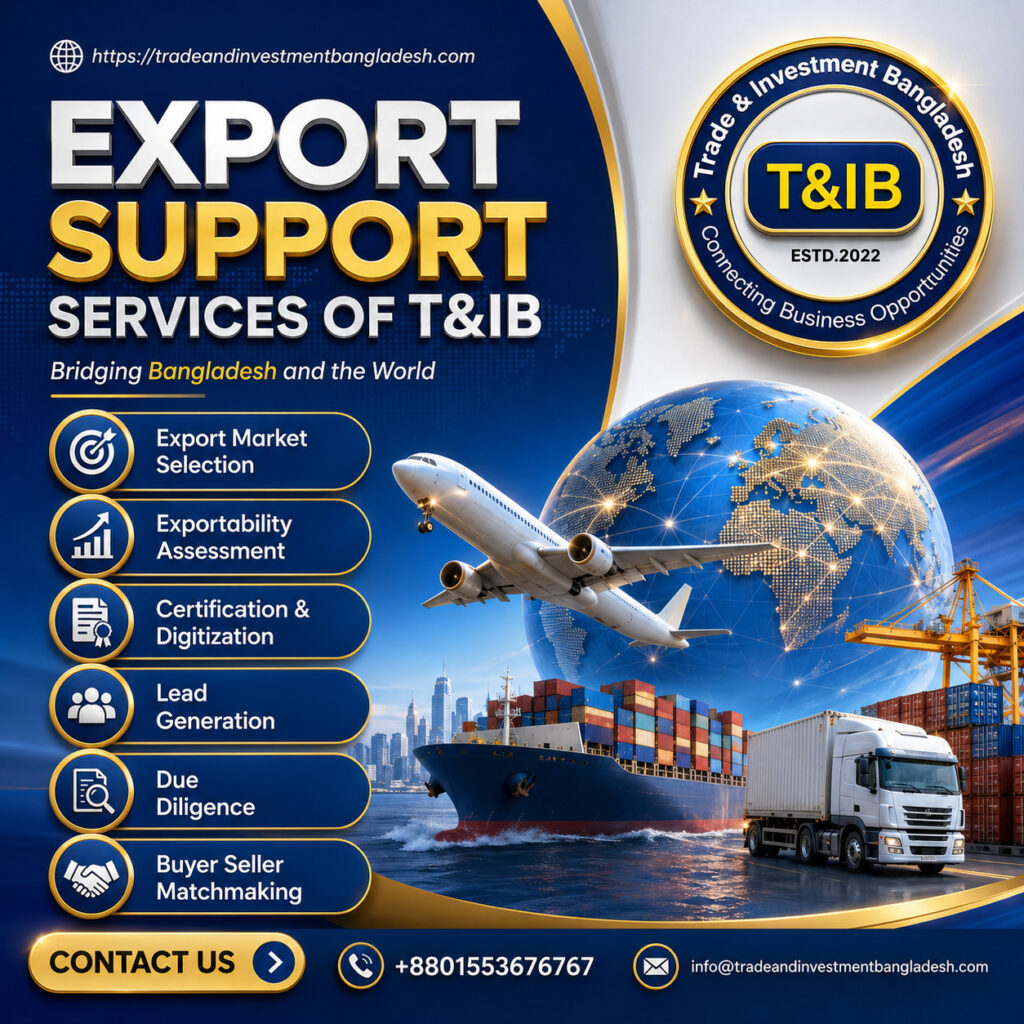
Entering international markets requires expertise, preparation, and reliable business networks. Trade & Investment Bangladesh (T&IB) offers comprehensive export support services to help Bangladeshi businesses successfully expand into global markets.
T&IB’s services include:
- Export Readiness Assessment
- International Market Research
- Product Positioning Strategy
- Export Business Planning
- International Buyer Identification
- Buyer–Seller Matchmaking
- Export Marketing Strategy
- Export Documentation Support
- Business Website Development
- Search Engine Optimization (SEO)
- Digital Marketing
- Trade Fair Participation Support
- Business Delegation Management
- B2B Meeting Facilitation
- Dealer and Distributor Recruitment
- Market Entry Consulting
Whether you are a first-time exporter or an established manufacturer seeking new international markets, T&IB provides practical, results-oriented guidance tailored to your business objectives.
Conclusion
Exporting is no longer limited to large corporations. With proper planning, market research, quality assurance, regulatory compliance, and effective marketing, even small and medium-sized enterprises in Bangladesh can successfully compete in international markets.
The twenty steps outlined in this guide provide a practical roadmap for entrepreneurs who aspire to transform their businesses from local enterprises into global suppliers. While the export journey requires patience, investment, and continuous learning, the rewards can be substantial higher revenues, diversified markets, stronger brands, and long-term business sustainability.
Bangladesh possesses significant competitive advantages in manufacturing, agriculture, technology, and value-added industries. Entrepreneurs who prepare systematically, invest in quality, embrace digital tools, and build lasting relationships with international buyers will be well positioned to capitalize on the growing opportunities in global trade.
Export success is not achieved overnight. It is built through careful planning, consistent quality, professional communication, and a commitment to meeting international standards. By following this step-by-step guide and seeking expert support, when necessary, Bangladeshi entrepreneurs can confidently enter global markets and contribute to the continued growth of Bangladesh’s export economy.
Comments