
Md. Joynal Abdin
Founder & Chief Executive Officer, Trade & Investment Bangladesh (T&IB)
Editor, T&IB Business Directory; Executive Director, Online Training Academy (OTA)
Secretary General, Brazil Bangladesh Chamber of Commerce & Industry (BBCCI)
Digital marketing has become one of the most important drivers of business growth in the modern economy because customers now discover brands, compare suppliers, evaluate credibility, and make purchase decisions through digital channels before they ever speak to a sales team. The size of the digital marketplace makes this shift impossible to ignore. According to the International Telecommunication Union, nearly three-quarters of the world’s population is now online, while DataReportal reported that Bangladesh had 77.7 million internet users and 60.0 million social media user identities in January 2025. At the same time, the commercial value of digital channels continues to expand rapidly; the IAB reported that internet advertising revenue reached a record $259 billion in 2024. These figures make one point very clear: digital visibility is no longer optional for serious businesses. It is now a core part of brand positioning, customer acquisition, lead generation, and market expansion.
For local and foreign businesses alike, digital marketing offers a practical way to connect with target audiences in measurable, scalable, and cost-efficient ways. A business in Bangladesh can now reach customers in Dhaka, Chattogram, Dubai, London, or São Paulo through the same digital infrastructure, provided its strategy is properly designed. Likewise, a foreign company entering Bangladesh can use digital channels to introduce its brand, educate the market, test customer response, and build commercial trust without depending only on traditional advertising or physical presence. That is why digital marketing is now closely linked not just with promotion, but also with business development, customer service, brand authority, and long-term competitiveness.
This article presents an in-depth discussion of digital marketing, including its definition, major tools and techniques, the business benefits of each method, and the practical value of professional digital marketing support. It is written for local and foreign businesses seeking dependable digital marketing services and a clearer understanding of how digital channels can support business growth.
What Is Digital Marketing?
Digital marketing is the strategic use of digital channels, platforms, content, tools, and data to promote products or services, reach defined target audiences, generate commercial interest, nurture customer relationships, and convert business opportunities into measurable results. The American Marketing Association explains digital marketing as marketing conducted through electronic devices and digital channels such as websites, search engines, blogs, social media, video, email, and similar online platforms. In practical business terms, digital marketing is the organized process of making a business visible, attractive, credible, and accessible to the people most likely to buy from it.
Unlike traditional marketing, digital marketing offers both precision and measurability. A newspaper advertisement or billboard may create visibility, but it is often difficult to know exactly who saw it, who engaged with it, and what business results came from it. Digital marketing is different. It allows companies to track website visitors, ad clicks, social media engagement, inquiry submissions, email opens, keyword rankings, and conversion behavior. This ability to monitor performance makes digital marketing especially valuable for businesses that want to allocate budget carefully, improve campaign efficiency, and scale growth based on evidence rather than guesswork.
Digital marketing is also broader than many people assume. It is not limited to posting on Facebook or running an occasional advertisement. A complete digital marketing strategy may include website development, search engine optimization, search engine advertising, social media management, email campaigns, content writing, video promotion, retargeting, analytics, customer relationship tools, online reputation management, and marketing automation. When these elements work together, they create a full digital growth system rather than a set of disconnected activities.
Why Digital Marketing Matters in Today’s Business Environment
The importance of digital marketing is directly connected to changing customer behavior. Buyers now research before they respond. They search on Google, read reviews, compare competitors, watch product videos, visit websites, check social profiles, and evaluate trust signals before sending an inquiry. If a business cannot be found online, or if its digital presence appears weak or outdated, many potential customers may assume the business is inactive, less professional, or less capable than competitors.
Digital marketing matters because it helps businesses appear where modern customers are already spending time. With billions of people online globally and tens of millions connected in Bangladesh, digital platforms now function as marketplaces, showrooms, communication channels, brand-building spaces, and lead-generation tools all at once. The commercial scale of this environment is reflected in ad spending trends such as the IAB’s reported $259 billion in internet advertising revenue in 2024, which indicates how strongly companies continue to invest in digital channels to attract customers and defend market share.
For small and medium-sized enterprises, digital marketing is particularly powerful because it lowers barriers to market entry. A smaller business with a professional website, clear messaging, optimized search presence, and strong social content can compete effectively against larger organizations in targeted niches. For exporters, consultants, training providers, manufacturers, and service firms, digital marketing creates opportunities to attract buyers and partners beyond geographic boundaries. In this sense, digital marketing supports not only promotion, but also market access and international business visibility.
Popular Digital Marketing Tools and Techniques
1. Website Marketing
A business website is the foundation of digital marketing because it serves as the primary digital destination where prospects learn about the company, review its services, assess credibility, and decide whether to make contact. A professional website should be fast, mobile-friendly, easy to navigate, clearly written, visually consistent, and designed to convert visitors into inquiries. It should include strong home page messaging, clear service descriptions, contact forms, trust signals, business credentials, and well-structured landing pages.
The business benefit of website marketing is that it gives a company full control over its digital identity. Unlike social platforms, where algorithms and policies can change at any time, a business website is owned media. It acts as the center of all digital activity. Traffic from search engines, paid ads, social media posts, email campaigns, and directory listings can all be directed to the website, where visitors can be guided toward inquiry, purchase, booking, or registration. A strong website therefore improves credibility, supports lead generation, and strengthens the commercial impact of all other digital channels.
2. Search Engine Optimization (SEO)
Search engine optimization, widely known as SEO, is the process of improving a website’s visibility in search engine results for keywords that matter to the target audience. This includes keyword research, content optimization, page structure improvement, technical fixes, internal linking, mobile usability, page speed enhancement, local optimization, and the development of useful content that matches search intent.
SEO is important because search engines remain one of the most valuable sources of high-intent traffic. When users search for terms such as “digital marketing company in Bangladesh,” “export consultant,” “business training provider,” or “best sourcing partner,” they are already expressing interest. Appearing prominently for those searches can bring highly qualified visitors to a website. The business benefit of SEO is long-term and compounding. Good SEO can improve visibility, reduce dependence on paid advertising, strengthen brand authority, attract decision-ready traffic, and deliver leads over a sustained period. Because SEO is built around discoverability, it is especially important for businesses that want to be found by new customers organically.
3. Search Engine Marketing (SEM) and Pay-Per-Click Advertising (PPC)
Search engine marketing refers to paid visibility on search engines, usually through pay-per-click advertising. With PPC campaigns, businesses can display ads for selected keywords and pay only when someone clicks. This method is highly useful when a company wants immediate visibility, especially for competitive terms where organic ranking may take time.
The advantage of SEM is speed and targeting precision. A business can decide which keywords to target, which locations to cover, what budget to allocate, and what type of audience to reach. Ads can be connected directly to landing pages designed for lead generation, product inquiry, booking, or registration. The business benefit of PPC is rapid lead generation, immediate market presence, measurable performance, and budget control. It is especially effective for new product launches, event promotion, urgent campaigns, and businesses that need quick inquiry generation while waiting for organic SEO to mature.
4. Content Marketing
Content marketing is the practice of creating and publishing useful, relevant, and valuable content to attract and engage a clearly defined audience. This content may include articles, blogs, case studies, market guides, service pages, downloadable resources, company profiles, newsletters, brochures, and educational materials. Rather than focusing only on direct selling, content marketing builds trust by answering questions, solving problems, and demonstrating expertise.
The business benefit of content marketing is authority building. When a business consistently publishes informative, relevant content, it positions itself as knowledgeable and trustworthy. This improves audience confidence and often shortens the sales cycle because prospects arrive better informed. Content marketing also supports SEO by helping a website rank for more keywords and topics. In addition, it gives sales teams, business development teams, and customer service teams stronger materials to share with prospects and clients. High-quality content works as both a visibility tool and a relationship-building asset.
5. Social Media Marketing
Social media marketing involves using platforms such as Facebook, LinkedIn, Instagram, YouTube, and other relevant networks to build audience engagement, share business content, increase visibility, and strengthen brand recognition. Each platform has a different commercial role. LinkedIn is often powerful for B2B positioning and professional networking. Facebook supports broad engagement and community connection. Instagram is useful for visual presentation and branding. YouTube supports education, product explanation, and long-form visibility through video.
The business benefit of social media marketing is direct access to audience attention. Social platforms allow businesses to stay visible, humanize their brand, showcase expertise, announce updates, promote offers, and interact with customers in real time. Social media also supports event promotion, public relations, customer feedback, and brand storytelling. In many industries, a strong social presence improves trust because potential clients often check a company’s activity before making contact. Consistent social media marketing therefore supports both awareness and credibility.
6. Social Media Advertising
Social media advertising uses paid campaigns on platforms such as Facebook, Instagram, LinkedIn, and YouTube to target specific audiences based on location, interests, behavior, job title, industry, age group, or custom data. Unlike organic posting, paid social campaigns can be scaled more predictably and are designed to reach beyond a page’s existing followers.
The business benefit of social media advertising is focused reach. It allows businesses to promote specific messages, offers, events, products, or services to people who closely match their target customer profile. A business can test different audience segments, formats, and messages to see which combination performs best. This makes social advertising especially effective for awareness campaigns, lead forms, webinar promotion, new market entry, product launches, and retargeting campaigns. For businesses with limited budgets, even modest paid social campaigns can produce useful market response when well targeted.
7. Email Marketing
Email marketing remains one of the most dependable digital marketing channels because it allows businesses to communicate directly with subscribers, prospects, customers, members, and partners. Email campaigns can include newsletters, promotional messages, event invitations, follow-up sequences, educational content, service updates, and personalized offers. Since an email list is owned by the business, it provides a more stable communication asset than relying entirely on third-party social platforms.
The business benefit of email marketing is relationship continuity. It allows businesses to stay connected with audiences over time, nurture leads gradually, encourage repeat purchases, re-engage inactive contacts, and deliver targeted messaging to segmented groups. Email is especially useful when a business wants to maintain professional communication with clients, members, buyers, or event participants. Because messages can be personalized and automated, email marketing combines scale with relevance, making it valuable for both customer retention and lead conversion.
8. Video Marketing
Video marketing uses short and long video content to explain services, demonstrate products, tell brand stories, show behind-the-scenes processes, publish testimonials, and educate audiences. Video may be used on websites, YouTube, LinkedIn, Facebook, Instagram, and within ad campaigns. Its importance continues to grow as businesses compete for attention in increasingly crowded digital spaces.
The commercial significance of video is reflected in broader advertising trends. The IAB reported strong growth in internet advertising overall, and digital video remains one of the most strategically important formats in modern campaigns. Video helps communicate more quickly and memorably than text alone. The business benefit of video marketing is higher engagement, stronger emotional connection, better message retention, and more persuasive brand communication. It is especially effective for complex services, product demonstrations, and trust-building campaigns where seeing and hearing adds confidence.
9. Mobile Marketing
Mobile marketing focuses on reaching customers through smartphones and tablets using mobile-friendly websites, mobile ads, SMS messaging, apps, responsive landing pages, and mobile-first content formats. This is essential because a large share of internet usage now takes place on mobile devices, especially in emerging markets and among social media users.
The business benefit of mobile marketing is accessibility and convenience. A business that optimizes its digital presence for mobile users can reduce friction, improve user experience, and increase conversion rates. Mobile-ready forms, fast-loading pages, click-to-call options, WhatsApp integration, and location-aware messaging can all improve inquiry generation. In practical terms, mobile marketing helps businesses meet customers where they already are: on their phones, during everyday decision-making moments.
10.Local SEO and Google Business Presence
Local SEO is a specialized digital marketing technique focused on helping businesses appear in location-based searches. It includes optimizing local keywords, managing Google Business profiles, collecting reviews, maintaining consistent contact information, and building location-relevant pages. This is especially valuable for agencies, consultants, clinics, training providers, offices, showrooms, restaurants, and service businesses that operate in specific geographic areas.
The business benefit of local SEO is higher visibility among nearby or area-specific customers. When people search for services “near me” or within a city or region, strong local optimization can increase calls, visits, map actions, and direct inquiries. Reviews also play a major role in trust. A professional local presence makes a business easier to find and easier to trust, which directly supports customer acquisition.
11.Influencer and Creator Marketing
Influencer and creator marketing involves partnering with individuals who have established audience trust and content reach within a particular niche. These creators may be industry voices, lifestyle personalities, technical educators, reviewers, or business-focused commentators. The goal is not merely borrowed visibility, but trusted communication delivered through a relevant voice.
The importance of creator-led promotion has increased significantly. The IAB projected that creator-related ad spending would reach $37 billion in 2025, reflecting how seriously brands now treat creator partnerships as part of mainstream digital strategy. The business benefit of influencer marketing is faster trust transfer, stronger engagement potential, and access to targeted communities that may be difficult to reach through traditional channels. When done thoughtfully, creator collaborations can improve awareness, perception, and response rates.
12.Marketing Automation
Marketing automation uses software systems to streamline repetitive marketing actions such as email follow-ups, lead nurturing, reminder sequences, segmentation, drip campaigns, customer journey triggers, and campaign workflows. Instead of sending every message manually, businesses can design sequences that respond to audience behavior and timing.
The business benefit of marketing automation is efficiency with consistency. It helps businesses respond faster to leads, maintain regular communication, reduce manual workload, and support prospects through a structured decision journey. This is especially useful for businesses that receive many inquiries or run multiple campaigns at once. Automation improves response discipline, which often leads to better conversion performance because prospects are less likely to be forgotten or delayed.
13.Customer Relationship Management (CRM)
CRM tools help businesses organize contacts, inquiries, opportunities, follow-up records, customer history, and sales stages in one centralized system. In digital marketing, CRM is important because it connects marketing activity with sales results. It helps answer not only where leads came from, but also which channels produce quality opportunities and long-term customers.
The business benefit of CRM is better commercial control. It reduces the risk of missed follow-ups, improves team coordination, supports pipeline visibility, and enables better customer retention. When CRM is connected to forms, ads, and email systems, it becomes possible to track the customer journey from first click to final transaction. This makes digital marketing more accountable and more valuable to business management.
14.Analytics and Performance Measurement
Analytics is the measurement layer of digital marketing. It includes website traffic tracking, keyword performance monitoring, ad result analysis, social media insights, user behavior review, conversion tracking, and campaign reporting. Without analytics, digital marketing becomes guesswork. With analytics, strategy becomes evidence-based.
The business benefit of analytics is informed decision-making. It helps identify which pages perform well, which ads convert, which content attracts engagement, which channels waste budget, and which audience segments show commercial potential. Analytics allows businesses to refine campaigns, improve return on investment, and make marketing more efficient over time. For businesses seeking growth, analytics transforms digital marketing from activity into managed performance.

Business Benefits of Digital Marketing Tools and Techniques as a Whole
When the above tools and techniques are integrated into one strategy, digital marketing becomes more than a communication system. It becomes a business growth framework. It helps companies attract relevant attention, build authority, generate leads, shorten decision cycles, strengthen customer trust, and improve commercial consistency. One of its greatest advantages is measurability. Businesses can track what works, improve what does not, and scale results with greater confidence.
Another major advantage is flexibility. A small business may begin with a basic website, a few service pages, a LinkedIn presence, and occasional content updates. Over time, it may expand into SEO, email campaigns, paid ads, video, automation, and CRM integration. This means digital marketing can grow with the business. It is not reserved for large corporations alone. It is equally useful for startups, consultancies, training institutes, exporters, manufacturers, associations, and service providers.
For foreign companies, digital marketing can simplify market entry by creating awareness and trust before physical expansion. For Bangladeshi businesses, it can support export promotion, buyer discovery, professional branding, and international communication. In both cases, digital marketing reduces dependence on chance visibility and creates a more deliberate path to market reach.
Digital Marketing Services of T&IB
Trade & Investment Bangladesh, widely known as T&IB, can play a highly practical role in supporting local and foreign businesses with professional digital marketing services. Because many businesses need not only promotion but also structured business communication, T&IB can combine marketing support with business-oriented positioning. This makes its service model especially valuable for companies that want their digital presence to generate real business inquiries, partnerships, membership growth, event participation, or export opportunities.
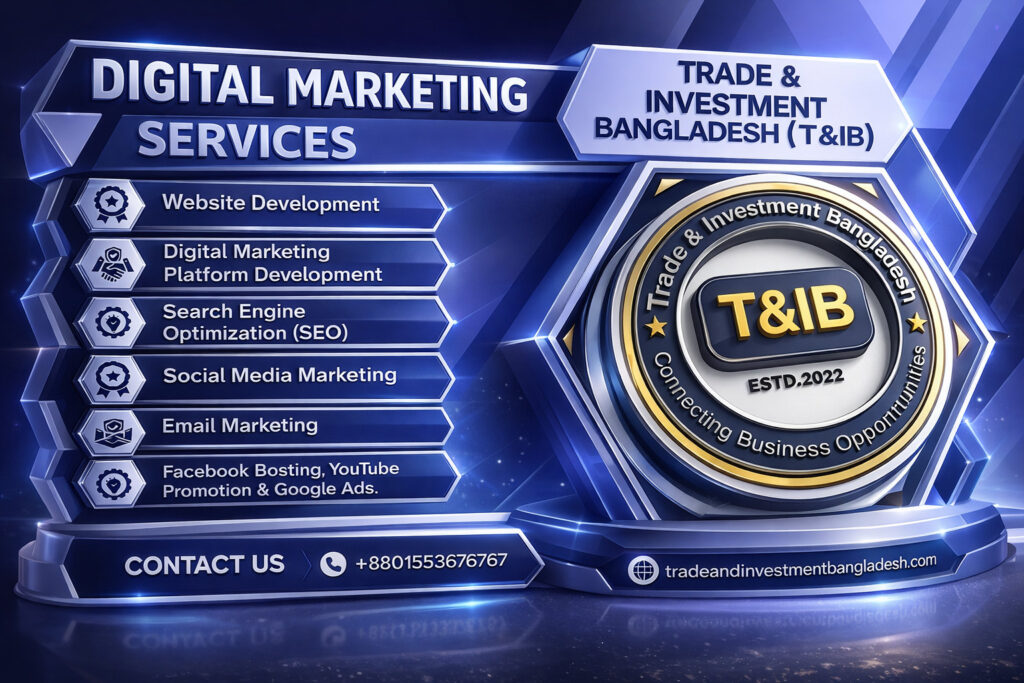
T&IB’s digital marketing services may include website content writing, corporate profile development, search engine optimization support, social media content planning, page management, article writing, digital brochure preparation, business listing optimization, paid campaign assistance, LinkedIn positioning, email marketing support, online brand communication, and digital visibility enhancement for local and international audiences. These services can be tailored for manufacturers, exporters, importers, service firms, trade organizations, educational platforms, consultancies, and investment-focused institutions.
A major strength of T&IB’s approach can be its focus on commercial relevance. Many businesses post content online without a clear objective. T&IB can help align digital marketing activity with business outcomes such as lead generation, buyer engagement, exporter branding, membership promotion, trade event outreach, and cross-border communication. This makes digital marketing more strategic and less random.
T&IB can also support integrated digital branding. This means ensuring that website content, social media posts, company profiles, online directory listings, digital brochures, email messages, and campaign materials all communicate a consistent business identity. Consistency is essential because professional trust is built not only by visibility, but by coherence. When a company presents itself clearly and consistently across channels, prospects feel more confident in engaging with it.
For local businesses, T&IB’s services can help improve discoverability, modernize online communication, and generate more qualified leads. For foreign businesses entering Bangladesh, T&IB can help localize messaging, build market-facing digital materials, and create a stronger first impression in the Bangladeshi market. This dual perspective makes T&IB a useful digital marketing partner for businesses with domestic or international ambitions.
Conclusion
Digital marketing is no longer a secondary promotional option. It is now one of the most essential systems for modern business visibility, reputation, customer acquisition, and long-term growth. As global internet adoption continues to expand and Bangladesh’s digital user base remains substantial, businesses must treat digital presence as a strategic asset rather than a side activity. The growth of internet advertising revenue and the rising importance of content, search, video, and creator-led promotion all point in the same direction: digital channels are where commercial attention now lives.
A successful digital marketing strategy is built on the right combination of website quality, search visibility, useful content, social engagement, paid promotion, customer communication, analytics, and conversion discipline. Each tool and technique contributes differently, but together they create a structured system that turns online visibility into real business opportunity. Businesses that invest thoughtfully in digital marketing are better positioned to compete, adapt, and grow.
For local and foreign businesses seeking dependable support, T&IB can serve as a practical digital marketing partner by helping them strengthen online presence, improve commercial communication, and convert digital attention into measurable business results. In today’s connected marketplace, digital marketing is not merely about being online. It is about being visible, trusted, persuasive, and commercially effective.
Comments